Oral conscious sedation is medication taken by mouth that helps a child feel calm and drowsy during dental treatment while staying awake enough to respond. Whether it is right for your child usually depends on three things: how much treatment is needed, how your child copes with dental visits, and your child’s overall health, especially breathing and airway health. For many children a gentler option is enough, and for a smaller group, general anesthesia in a hospital or surgical setting is the safer path.
At All Star Kidz Pediatrics, Dr. Christopher Lamb, a Diplomate of the American Board of Pediatric Dentistry, takes a careful, patient-centered approach to pediatric sedation dentistry, putting your child’s comfort and safety first. From mild anxiety to more significant behavior management needs, our team works closely with families in Centennial Hills and across Las Vegas to determine the level of support that fits each child. Below, we focus on the decision itself: who tends to be a good candidate, who may not be, and the questions worth asking before you agree to sedation.
What Is Oral Conscious Sedation?
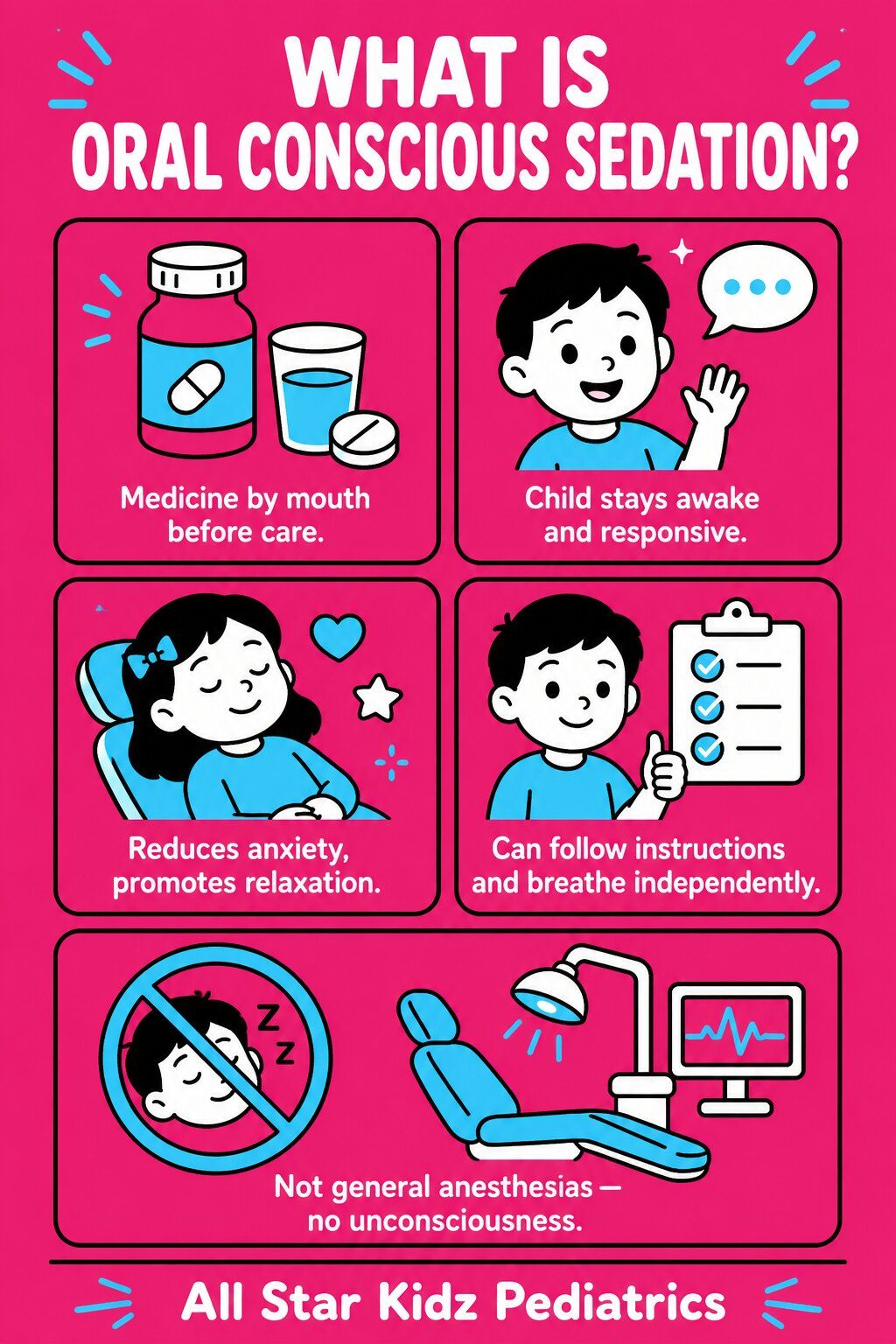
Oral conscious sedation involves giving a child medication by mouth before a dental procedure. The goal is to reduce anxiety and promote relaxation while allowing the child to remain awake and responsive. In the terms pediatric sedation guidelines use, this generally falls under moderate sedation, a level at which a child can still respond purposefully to a voice or a light touch and keeps breathing without assistance. Unlike general anesthesia, a child under oral conscious sedation can still follow simple instructions and respond to communication.
At All Star Kidz Pediatrics, we use a carefully evaluated combination of Demerol, chloral hydrate, and Vistaril for oral conscious sedation. This multi-agent approach has a long history in pediatric dentistry. A small crossover study of 10 children, published in Pediatric Dentistry, the journal of the American Academy of Pediatric Dentistry, found that adding meperidine (Demerol) to chloral hydrate and hydroxyzine pamoate (Vistaril) improved behavior during treatment, without an increase in breathing problems in that group. Because that study was small and is now decades old, it is one piece of evidence rather than a promise of how any one child will respond. Our team selects the medication and dose only after reviewing each child’s weight, health history, and planned treatment.
Where Oral Sedation Fits Among Your Child’s Options
Sedation is not one-size-fits-all. Pediatric dentists generally think of comfort options as a range from lightest to deepest, and oral conscious sedation sits in the middle of that range.
Comparing Sedation Levels
The mildest option is nitrous oxide, also called laughing gas, which is inhaled through a small mask and wears off quickly after the procedure. Oral conscious sedation provides a deeper level of relaxation, making it a better fit for children who need more significant calming support during treatment.
When General Anesthesia May Be Needed
On the other end of the spectrum, general anesthesia renders a child fully unconscious and is typically reserved for extensive procedures, very young children, or those requiring complete immobility. Oral conscious sedation offers meaningful anxiety relief with less medical complexity than general anesthesia, although recovery still takes several hours. For a closer side-by-side look, our article comparing conscious sedation and general anesthesia covers how the two differ in setting, monitoring, and recovery.
Signs Oral Sedation May Be a Good Fit
Not every child needs sedation, but some situations make it a thoughtful recommendation worth discussing with your child’s dentist.
Children Who May Benefit
Children who tend to benefit most from oral conscious sedation include those with significant dental anxiety, young patients who cannot cooperate for longer procedures, and children requiring multiple treatments in a single visit. Kids with sensory sensitivities, children with special needs who benefit from additional calming support, and those with previous negative dental experiences may also respond well to this approach.
Factors the Dentist Will Consider
Before recommending oral conscious sedation, Dr. Lamb reviews each child’s full medical and dental history, current health status, weight, and the nature of the procedure to be performed. Parents play a key role by sharing any medications their child takes, known allergies, snoring or breathing concerns, and previous reactions to sedatives. This evaluation helps us decide whether the option is appropriate for each individual patient.
When Oral Sedation May Not Be the Best Choice
Being honest about limits is part of a safe sedation plan. Oral sedation may be postponed for a child who has a cold, cough, or congestion on the day of the visit, since an irritated or stuffy airway raises the risk of breathing problems under sedation. Children with very large tonsils, loud snoring or sleep apnea, certain heart or lung conditions, or other complex medical needs may need clearance from their physician or care in a different setting altogether.
Oral medication also works differently from child to child. Because it is swallowed and absorbed gradually, its effect cannot be adjusted minute by minute the way inhaled nitrous oxide can, and some children remain tearful or restless even when sedated. If a child does not respond as expected, the safest choice may be to stop, reschedule, or plan treatment under general anesthesia instead. Very extensive treatment needs, or a child who is too young or too distressed to benefit from moderate sedation, are other common reasons a pediatric dentist may recommend a different approach.
Safety Standards Parents Should Know About
The American Academy of Pediatric Dentistry and the American Academy of Pediatrics share a guideline for monitoring and managing children before, during, and after sedation. It calls for sedating medication to be given only under the supervision of trained providers, for the team to have airway training along with age- and size-appropriate rescue equipment, and for a child to return to their pre-sedation level of alertness before leaving the office. Sedation is a continuum, and a child can occasionally become more deeply sedated than intended, which is why the ability to recognize and respond to that change matters so much.
Nevada adds its own layer of oversight: dentists must hold a permit from the Nevada State Board of Dental Examiners to provide moderate sedation. It is completely reasonable to ask any provider about their training, permits, monitoring equipment, and who will be watching your child during and after treatment.
Questions to Ask Before Your Child’s Sedation Visit
A good sedation consultation should leave you with clear answers. Questions many parents find helpful include:
- Why is sedation recommended for this visit, and what are the alternatives?
- Which medication will be used, and how is the dose determined?
- How will my child’s breathing, oxygen level, and heart rate be monitored?
- Who on the team is trained to respond if my child becomes more sedated than planned?
- What should we do about food, drinks, and regular medications beforehand?
- What needs to happen before my child is ready to go home?
Dr. Lamb welcomes these questions, and our article on how to prepare your child for a sedation dentistry appointment covers the practical side of getting ready.
What to Expect on the Day of the Appointment
On the day of a sedation appointment, follow the pre-procedure instructions you receive exactly, including fasting guidelines, which reduce the risk of complications. The medication is given in the office, and our team monitors your child closely throughout the entire appointment. For a step-by-step walk-through of the visit itself, see what to expect during your child’s sedation dentistry appointment.
After the procedure, your child is likely to be groggy and may need to be carried or assisted. Plan to stay home for the rest of the day, as the sedation effects may linger for several hours, and keep a close eye on your child while they rest. Some sleepiness and mild emotionality are normal during that time, and our guide to how long sedation takes to wear off explains the typical recovery timeline.
Frequently Asked Questions About Oral Conscious Sedation
Is oral conscious sedation safe for children?
When it is used for the right child, at a carefully calculated dose, with appropriate monitoring and a trained team, oral sedation has a long record of use in pediatric dentistry. No sedation is entirely without risk, which is why a thorough health review, careful fasting, and continuous monitoring are part of every sedation visit.
Will my child be asleep during oral sedation?
Usually not fully. Most children become relaxed and drowsy and may doze, but they can still respond to a voice or a gentle touch. Many children remember little of the visit afterward, although this varies from child to child.
How young can a child be for oral sedation?
There is no single age cutoff. Dr. Lamb considers your child’s weight, health, temperament, and the amount of treatment needed. For very young children who need extensive work, general anesthesia in a hospital or surgical setting is sometimes the safer recommendation.
Can my child eat before oral conscious sedation?
Your child will need to follow specific fasting instructions before the appointment, and those instructions should be followed exactly. An empty stomach lowers the risk of complications during sedation, so if your child eats or drinks outside the approved window, let our team know, since the visit may need to be rescheduled.
Does insurance cover oral sedation for dental work?
Coverage varies by plan. Some plans cover sedation when it is considered necessary to complete treatment safely, while others limit or exclude it. Our team can help check your specific benefits, including Nevada Medicaid, before the appointment.
Schedule a Consultation at All Star Kidz Pediatrics
At All Star Kidz Pediatrics, we take the trust parents place in our hands seriously, especially for sedation appointments. Dr. Lamb’s board certification by the American Board of Pediatric Dentistry reflects an advanced level of training and a commitment to high standards of care for children in Centennial Hills and throughout the greater Las Vegas area. We proudly accept most major dental insurance plans and Nevada Medicaid (Liberty), making quality pediatric dental care accessible to the families we serve.
If you are wondering whether oral conscious sedation is the right path for your child’s upcoming visit, we are here to help you find answers. Contact our office to schedule a consultation with Dr. Lamb and take the first step toward a calm, positive dental experience for your child.